
What an Englewood Resident Lookup Can Confirm
One name can surface in many Englewood records, and each appearance means something different. The county assessor can confirm a parcel and show an assessment owner label. A recorded instrument proves only one thing. Someone stood as grantor, grantee, trustee, or another named party on a document. Supply all four current fields and the voter lookup can match a registration. Courts reveal a scheduled event or hand over a requested public document. Historical collections can place a person at a street, school, business, or civic event. The year matters too. None of these alone tells the whole story.
| Record | What it confirms | Where | Access |
|---|---|---|---|
| Parcel result | PIN/AIN, situs, legal description, assessment owner label, physical facts | Arapahoe Assessor, Tax Search, GIS | Address, PIN, or AIN; not occupant proof |
| Recorded instrument | Party name, recorded event, instrument type, legal description | Clerk and Recorder | Free index; image and older-book limits |
| Voter registration | Matched status and possible address, party, precinct, district | Arapahoe Elections | First, last, birth date, and ZIP required |
| Court record | Hearing clue, case number, or requested order/disposition | Colorado Judicial or Englewood Municipal Court | Docket is limited; documents require the proper request |
| Vital record | Eligible birth, death, marriage, or divorce event | CDPHE, county, clerk, or district court | Confidential; relationship, authority, ID, and fee rules |
| Directory or newspaper | Dated name, address, household, school, business, or civic clue | Englewood Library, DPL, archives | Year, page, collection, and viewing restrictions |
Use the table as a guardrail against overclaiming. A resident lookup earns confidence when a name plus an address, date, parcel, year, or case number agrees across at least two independent sources.
Start an Englewood Match with Two Stable Identifiers
Place comes before person. Normalize a street address with USPS first. Then run the Arapahoe parcel search by Number, Range, Street Name, and Unit, or by PIN or AIN. Save what comes back: the situs, the legal description, neighborhood and code, and the result date. GIS can test the parcel centroid and jurisdiction. A deed connection means preserving the reception number or book and page. A court connection means keeping the court, county, case number, year, and date together.
Two stable identifiers beat one every time. Good pairs include a full name plus address and date, name plus parcel legal description, name plus case number and year, or name plus directory year and street. A similar first name, a shared surname, a mailing address, or an old phone listing does not qualify. When records conflict, keep both labeled. Never merge them quietly.
Match rule. An Englewood resident lookup should preserve an unresolved match as unresolved until a second stable field supports it.
Four Fields in Arapahoe’s Voter Lookup
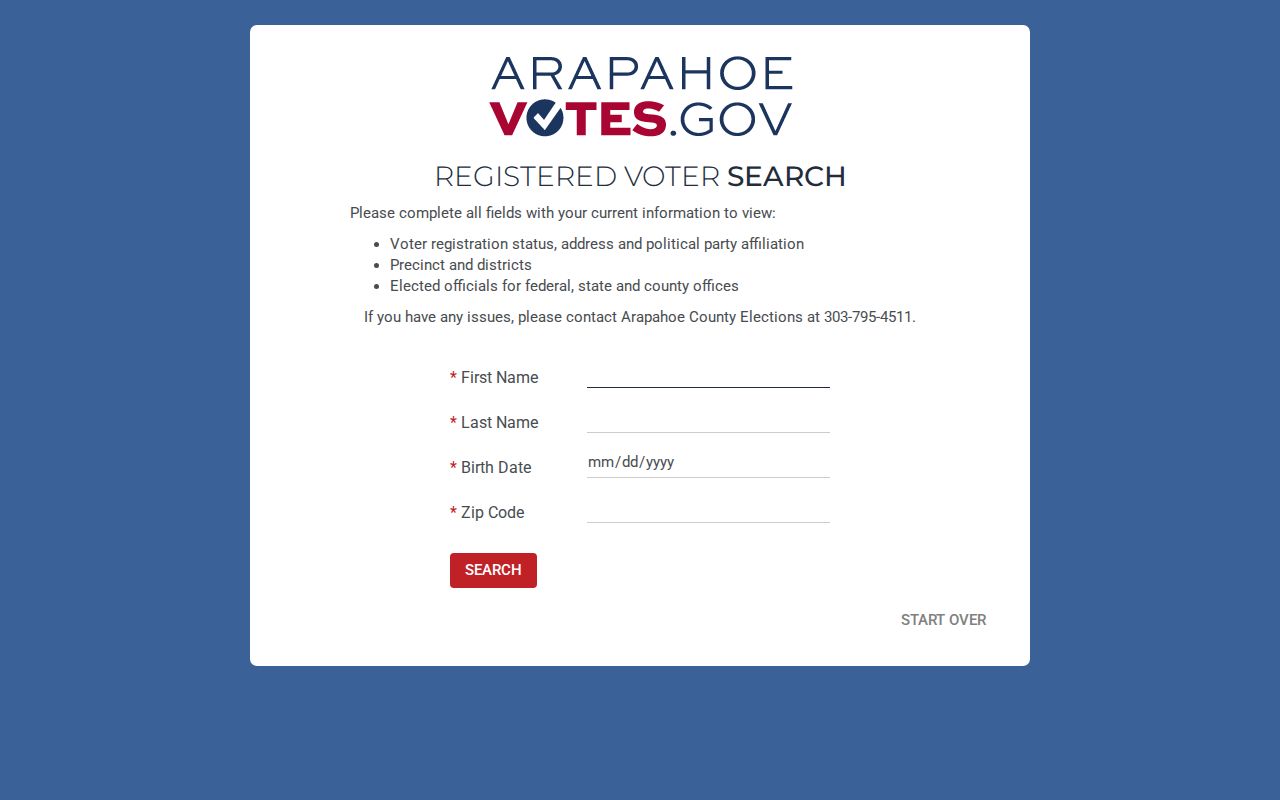
The county voter lookup is deliberately narrow. The current form demands first name, last name, birth date, and ZIP. Search and Start Over controls sit alongside it. A successful match may show registration status and address where public. Party, precinct or district, and elected officials can appear too. It is not a public name browser. The required ZIP does not turn it into a ZIP-wide search either.
| Field or result | Use in a resident lookup |
|---|---|
| First name and last name | Match the known spelling; avoid merging common-name results. |
| Birth date | Used for identity matching; do not publish the full date. |
| ZIP | Required input for the county match, not a geography filter. |
| Status | Shows a registration state at the time of the lookup. |
| Address, party, precinct, district, officials | May appear where public; protected or confidential fields are excluded. |
GoVote Colorado handles registration, address changes, and ballot status. It also covers sample ballots, BallotTrax, curing, and related actions. Elections also describes signed data requests by mail, fax, email, and in person. Colorado's Address Confidentiality Program and the county confidential-voter process matter here. An absent or substitute address can be a protection rather than a failed search.
The blank Arapahoe voter lookup form shows the four required match fields without exposing a live person.
State Dockets, Municipal Cases, and Full Documents
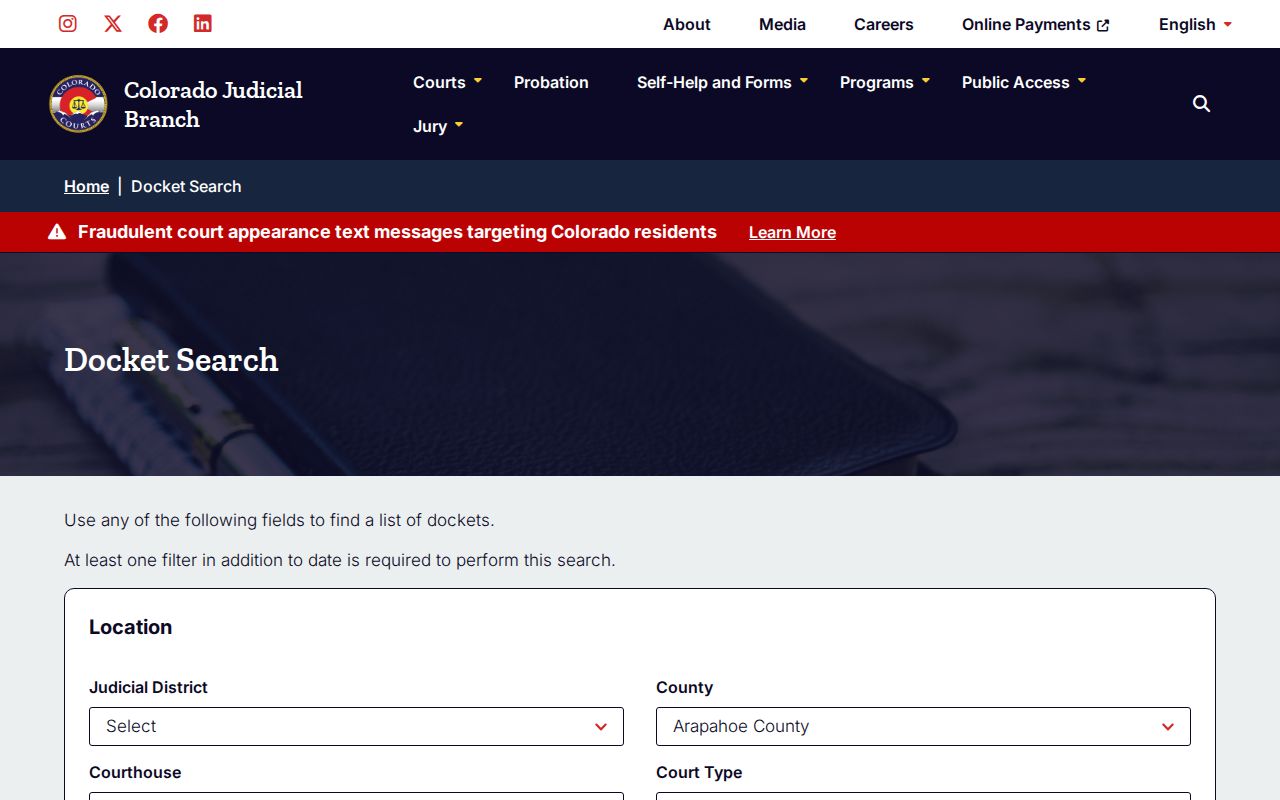
The Colorado Judicial Branch docket search covers the 18th Judicial District. Its filters include Court Type, Division, Date or Date Range, Case Number Year and Sequence, Case Class, party type and name, and attorney fields. It also offers Search, Export, and Printable controls. Results default to 20 rows. A single row can display hearing date and time, case number, hearing type, location, courtroom, and appearance information. Treat it as a schedule or index clue, not the full case file.
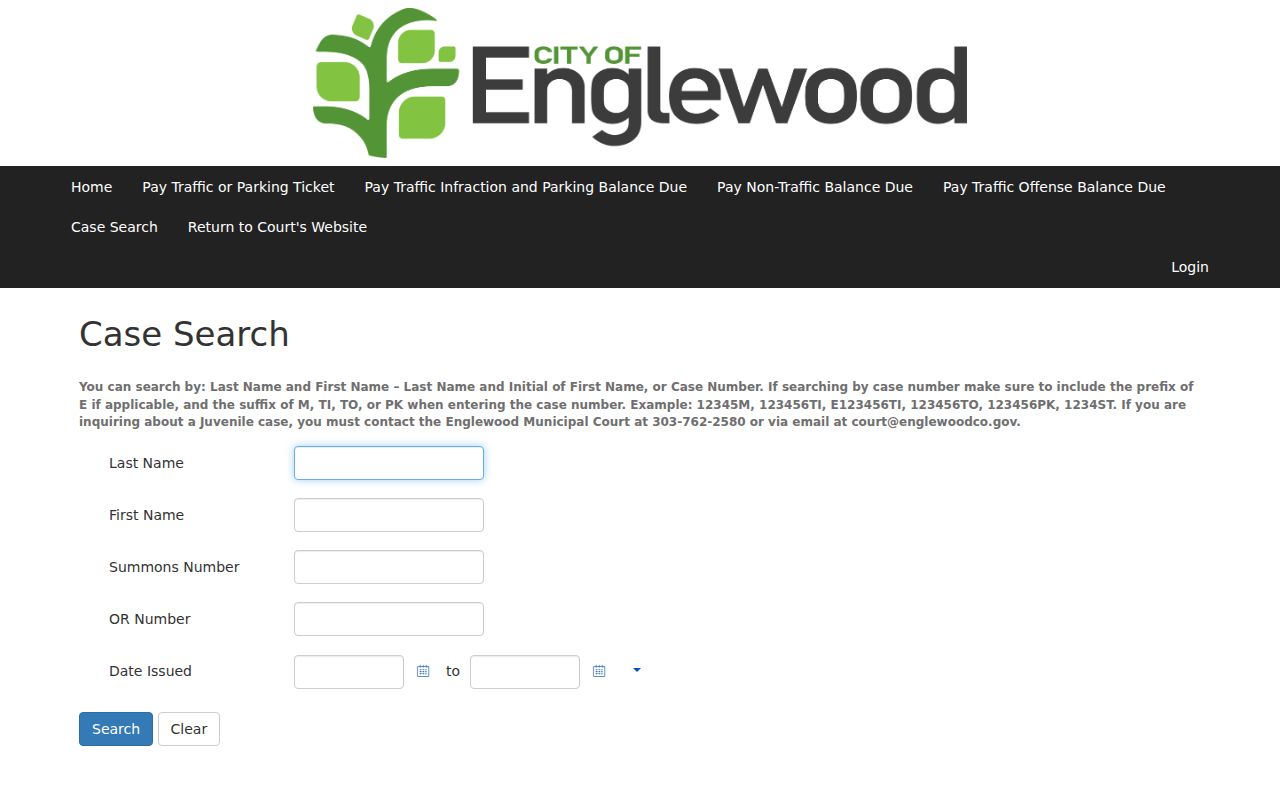
Englewood Municipal Court runs a separate search. Fields cover Last Name, First Name, Summons Number, and OR Number. Operators include contains or starts with. Date presets, Search, and Clear round out the form. Online document visibility may be limited or login-gated. Police reports and state criminal-history records come from their originating agencies, not automatically from the court.
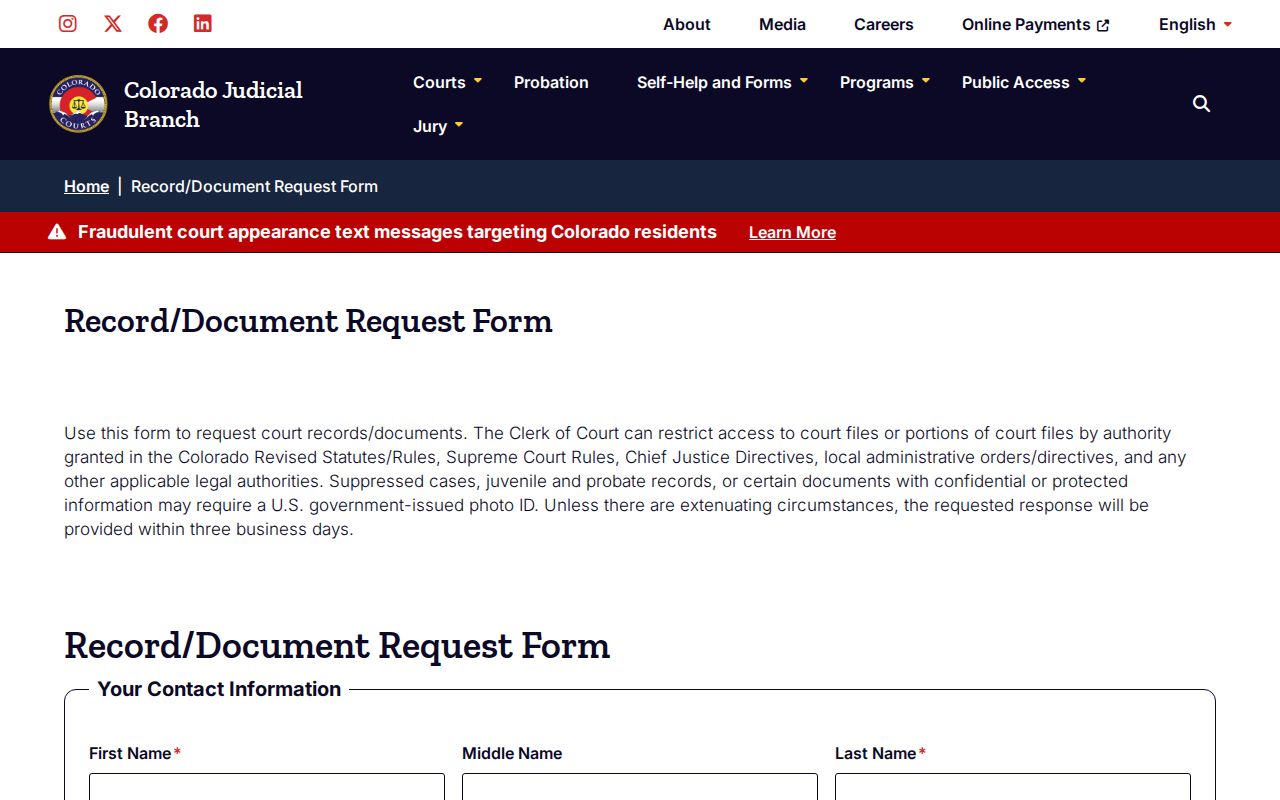
Need the document itself? Use the Judicial request form with requester contact, case number, type, year, county, optional identifying clues, and a document category. Family, criminal, civil, probate, register-of-actions, certified, and exemplified requests each follow separate rules. A usual response runs about three business days. Redaction, research, retrieval, and restricted records can change the path.
In-person state-court access is available at the Centennial Justice Center and Littleton Courthouse during posted weekday hours. Arapahoe Judicial lists 303-645-6600 and 18records@judicial.state.co.us. The request route also supports email, mail, and the public counter. Englewood Municipal Court lists 303-762-2580 and court@englewoodco.gov, with weekday counter hours of 8:30 a.m.–4:30 p.m. For a police or Sheriff report, go to the originating agency.
The Colorado Judicial Arapahoe docket search illustrates the schedule-level fields used in a resident lookup.
The docket is the first court clue. When the question depends on the text of an order, judgment, or register, a document request is the next step.
The Colorado court document request form lists the identity, case, county, and document fields needed for a fuller record.
What a Public Court Result Actually Shows
A public court result is easy to overread. The Arapahoe docket sample showed a hearing date and time, an anonymized party-name field, case number, hearing type, location, courtroom, and appearance mode. Numbering patterns included 2026M4402, 2026CV30198, and 2025CR1767. Those patterns identify a case route and year style, nothing more. Not a person, an outcome, or a complete history.
- County and court type, so a city case is not confused with a state case.
- Case number and year, which provide the strongest request key.
- Hearing date, time, type, location, and courtroom.
- Party or attorney fields, subject to the portal’s public display.
- Appearance or status information, without assuming a final disposition.
- Docket
- A court schedule or index of events, not the full case file.
- Index versus image
- An index points to a record; a document image or requested copy carries the underlying text.
- Certified copy
- A copy formally authenticated by the custodian for a stated use.
- Disposition
- The recorded outcome or status of a case event, which may require the underlying court document.
An Englewood resident lookup works best when it stops at what a filing actually says. Hearing listings are not verdicts. Court files can be sealed, suppressed, juvenile, probate-limited, or redacted, so a docket line never tells the whole story.
Birth and Death Certificates Need Eligibility
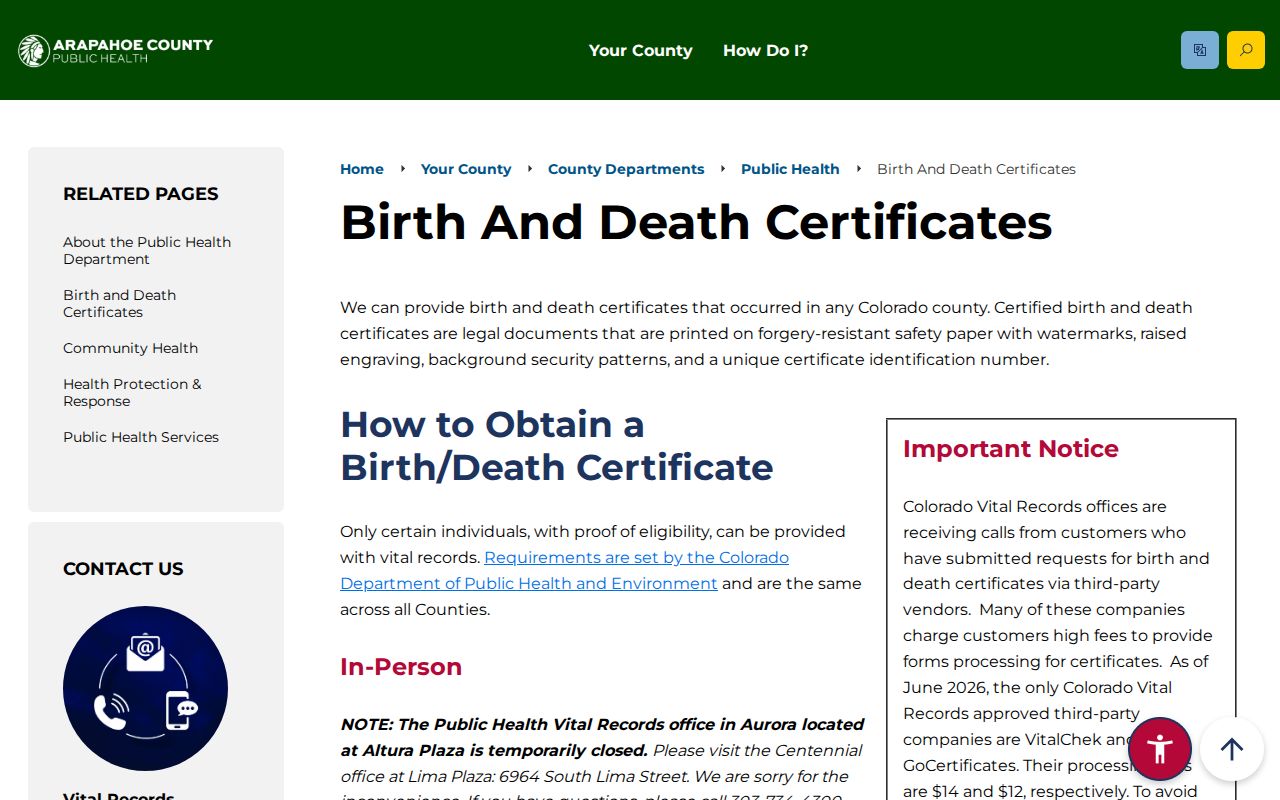
Colorado vital records stay confidential. CDPHE sets the statewide policy. No resident lookup by name is possible for births and deaths. Arapahoe Public Health issues eligible Colorado certificates locally, no matter which county registered the event. The office sits in Centennial Lima Plaza. It handles requests in person, by mail, by email, or through an approved vendor. Appointments are recommended. Marriage certificates belong to the county clerk and recorder. Divorce decrees belong to the district court.
The application asks who is requesting the record and why. Expect to supply your name, contact and mailing details, and relationship to the subject. Also include purpose, event date and place, subject identifiers, ID, payment, signature, quantity, and certificate type. The death form offers Long Legal, Short Legal, and Verification versions. A first copy costs $25, and each additional copy of the same record is $20. Delivery and vendor fees can add to the total. Eligibility turns on immediate family, legal representation, government purpose, or a direct and tangible interest. Grandparents and grandchildren do not count as automatic immediate family under current county guidance.
The Arapahoe Vital Records page identifies the local certificate application channels and eligibility rules.
Recorded Parties Are Not Automatically Residents
A recorder index can tie a name to a grantor, grantee, trustee, lien, easement, plat, release, or another recorded instrument. That is not the same as living there. The party could be a prior owner, a representative, a lender, or a business. It could also be anyone else who signed the paperwork. Advanced Search reaches across party names, grantor and grantee fields, recorded date, document type, reception number, book and page, OCR phrases, subdivision legal, and section legal. That makes it strong for tracing a parcel or an estate.
Write down the details that matter. Note the instrument date, recording date, reception number, legal description, party role, document type, and whether an image is accessible. Indexing guidance covers grantor and grantee entries from 1980 to the present. Earlier material may need book and page work or a visit to the office. Pre-1979 questions often do. QuickLink separately advertises a historical layer covering 1860 through 1902. A blank result may simply mean the wrong legal description or index layer. It does not mean that no record exists.
Englewood City Files and Public Affiliations
City systems tell a different story. Laserfiche, iMS, MUNIRevs, and a CORA request through the City Clerk can surface a project, permit, or meeting. The same sources can surface an ordinance, code event, or business-license tie. The city records page organizes council, Boards and Commissions, and election materials. Historic Englewood, police and code, building permits and reports, and finance collections appear there too. Building Division and Public Works records respond to an address, permit number, project, or date. Treat any city record as a civic or project connection rather than proof of residence.
State filings behave the same way. An SOS search reveals entity status, registered agent, and principal or mailing address. It also reveals filing history and documents. A DPO license profile can show status, discipline, restrictions, and business interests. Professionals may suppress a home address, though. Anchor your conclusion to the record date and the person's official role, never to an administrative address alone.
The Englewood Municipal Court search is a separate city-level route from state court records.
Official Records Versus Compiled Profiles
Official records and commercial people-finder profiles do different jobs. A compiled profile stitches together public filings, address fragments, marketing data, and licensed data into a paid summary. It can go stale. It can also merge strangers with similar names. An official record, by contrast, names a custodian, carries a date and jurisdiction, uses defined field labels, and offers a path to a corrected or formal copy.
| Question | Official custodian | Compiled profile |
|---|---|---|
| What is the parcel? | Assessor and GIS show the parcel, situs, and map context. | May repeat an address without parcel proof. |
| What was recorded? | Recorder supplies instrument fields and access status. | May summarize or omit the source document. |
| Is a court event documented? | Judicial or Municipal Court supplies the docket or request route. | May mix case labels or dates. |
| Can an error be corrected? | Ask the named custodian about its correction route. | Opt-out or dispute steps may not change the underlying record. |
For a lawful personal lookup, the better anchor is the source you can date and verify. No commercial category should replace the county, city, state, court, or library custodian.
Protected Addresses and Unresolved Matches
Some records sit outside a normal resident lookup for good reason. Colorado's Address Confidentiality Program supplies eligible survivors with a substitute address. The program also forwards their mail. A separate confidential-voter process shields certain registrations. The Driver's Privacy Protection Act limits personal information pulled from motor-vehicle files.
Vital, juvenile, sealed, suppressed, and personal-information records can carry additional restrictions on top of those. Do not assume a gap in the county records. A missing address may reflect a legal protection rather than an incomplete file.
Lawful use. Englewood resident lookup research is for family history, reconnecting, civic understanding, and personal safety awareness. Do not use records to stalk, harass, intimidate, or harm another person.
Honesty matters when a lookup result stays uncertain. Say so plainly. Preserve the source URL, the date, and the search key. Keep the jurisdiction and the record type too. The trail can then be rechecked later.
Ask the records custodian for a correction or an official copy whenever a public result looks incomplete. Never fold an assessor name, a voter address, a court event, and a vital clue into one profile without independent support for each piece.